

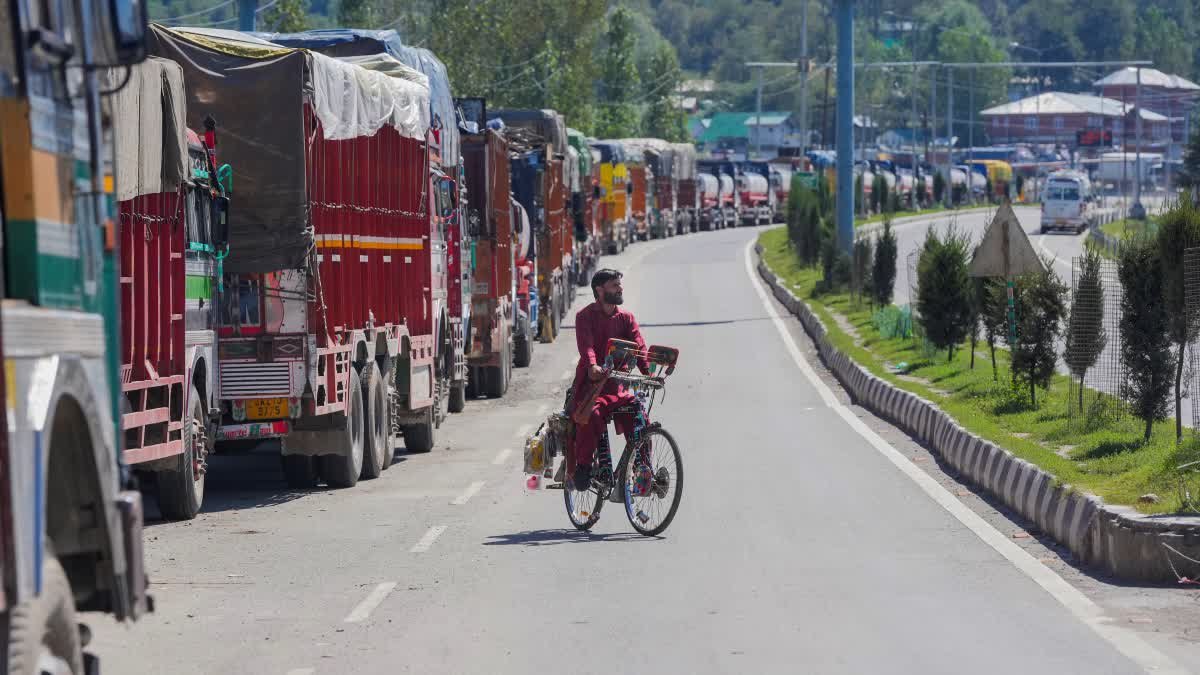

Jammu: With the Srinagar-Jammu national highway closed for heavy vehicles, dozens of trucks carrying sheep and goats have been stranded for over two weeks without food or water, leading to the deaths of several cattle. For over two weeks, thousands of animals have been stranded in metal containers under the scorching sun, their lives at risk, officials said. Some have already fainted and some look weak.
The 270-km highway is a vital route connecting Kashmir with the rest of the country. Heavy traffic has been blocked on it since the flash floods and landslides wreaked havoc around Udhampur last month. What was once a main route for trade has now become a nightmare for motorists.
For Khazir Muhammad Regu, head of the All Kashmir Butchers Association, the tragedy is both economic and moral. He has counted at least 65 trucks carrying cattle that had left Jammu for Srinagar but have not yet arrived.
“Each truck has around 180 animals. So, more than 11,000 goats and sheep are stuck. Some have died of hunger and thirst, many others are on the verge of death. A loss of Rs 16 crore has been incurred so far. But what is worse is that they are dying before our eyes,” he told ETV Bharat.
Kashmir’s meat supply is primarily dependent on its livestock industry. All wedding parties, all family functions and meat shops depend on the continuous movement of animals coming from other states. But with the highway blocked, Srinagar’s meat shops are already witnessing a shortage and prices are rising.
“These animals were bought with borrowed money. If they die like this, entire families dependent on this trade will be ruined. The government must intervene immediately. It involves the lives of both humans and animals,” Regu said. The crisis is not limited to livestock. The crisis has completely crippled Kashmir’s horticulture industry, especially the apple industry, which earns about Rs 8,000 crore every year and accounts for 80 per cent of India’s apple production. Apples, potatoes and onions are rotting in trucks stuck in kilometres-long traffic jams.
NHAI has completely failed…
Senior CPM leader and former Kulgam MLA Mohammad Yusuf Tarigami said, “All fruit markets are closed. Farmers are suffering the most. This is not a traffic problem but a livelihood crisis. The National Highways Authority of India (NHAI) has completely failed.”Tarigami questioned, “If the NHAI cannot repair one kilometre of road in 16 days, then what is the use of this organisation? Such an organisation has no moral right to charge toll on apple trucks. The government should also open cold storage units in every district so that farmers can keep their produce in such times. Otherwise we are making them bankrupt year after year.”
Traffic police statement
A top official of the IGP Traffic office confirmed to ETV Bharat that around 8,000 lorries are stuck on both sides of the highway. “These are trucks carrying animals and also trucks carrying fruits and vegetables. Our department monitors the situation round the clock, especially those carrying perishables and animals,” the official said. The drivers say they feel left out despite assurances. “We have no food, no water, no other facilities,” they said.
Sudarshan, a truck driver from Bengaluru, who left home a few weeks ago with a consignment of military uniforms, has been stranded near Nagrota for 15 days. “There are no facilities for us here. No food, no water, no toilet,” he said. Standing near his stranded truck, Sudarshan said, “We have run out of money. The police just tell us to wait. But waiting has become torture. We are living like prisoners on this road.”
Raj Dev, a truck driver from Bihar, has been waiting for days since he left Jammu. He said, “I pay Rs 40,000 every month to the bank for my truck loan. If this situation continues, I will be ruined. Who will help us? The government should reopen this road immediately.”
Struck on the other side of the highway, Aqib Ahmed, a driver from Bandipora district, had a similar story. He had brought goods from Haryana but has been stranded for several days. Aqib said, “We have nothing to eat, no place to sleep. Water is also running out. Some of us are borrowing biscuits from each other. If all this is not stopped, we will die of hunger even before our trucks start moving.”

