

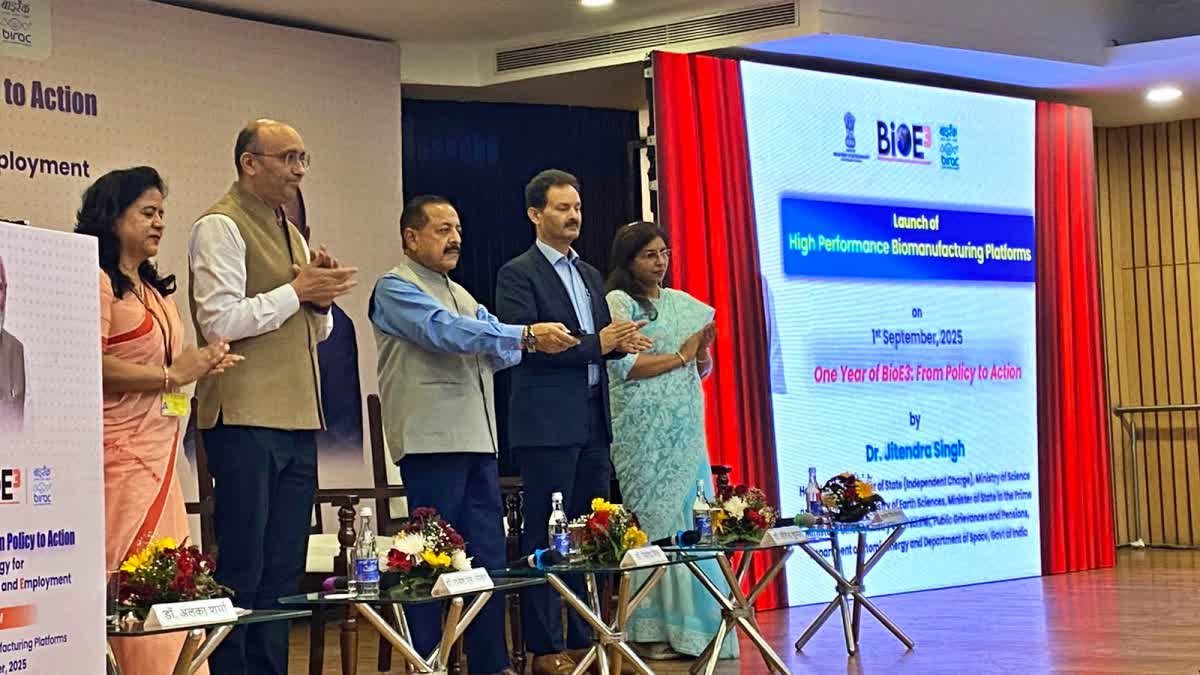

New Delhi: India has taken a significant step forward in biotechnology with the launch of the ambitious venture ‘High Performance Biomanufacturing Platform’ through the Department of Biotechnology (DBT) and Biotechnology Industry Research Assistance Council (BIRAC).
This landmark initiative was launched under the BioE3 policy (Biotechnology for Environment, Economy and Employment), which aims to provide facilities to encourage advanced biomanufacturing and contribute to India’s goal of a $300 billion bioeconomy by 2030.
Under the agreement signed on May 26, 2023, the new network has been established, representing 21 bio-enabled facilities across India, and providing shared infrastructure and pilot scale platforms to start-ups, small and medium enterprises (SMEs), industry and academic institutions.
Minister of State for Science and Technology Jitendra Singh said that this initiative is important for India’s innovation ecosystem. “The High Performance Biomanufacturing Platform will be a network of advanced bio-foundries and biomanufacturing nodes that will use state-of-the-art infrastructure, technology and expertise to scale up bio-based innovations from the laboratory to pilot and pre-commercial projects,” he said.
Singh emphasised that India is moving faster than in the past in technology adoption. “Unlike IT and computers, where we were at least a decade behind, this time we are among the first to initiate an institutional policy at the government level,” he said. With over 21 bio-foundries already operational and over 4,000 biotech start-ups, India is now established as a global biotech powerhouse, Singh said. “This is no small feat for a country like India. We have ensured that we leave no sector untouched—be it biopharma, bio-agri, bioservices or bio-industrial applications,” he stressed.
He estimated that India’s bioeconomy, which was just $10 billion a decade ago, is now on track to reach $300 billion by 2030. Beyond economics, Singh emphasised the geopolitical significance, saying, “These centres will reduce dependence on petroleum imports, create sustainable alternatives and contribute to India’s geopolitical empowerment. Biotechnology will be the next big buzzword after IT—by 2040, it will be like IT in the 1990s, and India’s youth will be the harbingers of this change.”
DBT Secretary Rajesh S. Gokhale called the initiative a watershed moment for India’s bioeconomy, and said the challenge now is to scale up laboratory innovations industrially. “We have launched high-performance biotechnology platforms. The challenge in biotechnology is how to scale it up. Research laboratories are providing innovations but they have not been able to scale them up. These biomanufacturing centres, which we call bio-enablers, really provide an opportunity for academics and scientists to collaborate with industry to develop products for the future of the country and the world,” he told ETV Bharat.
Outlining an ambitious expansion plan, Gokhale said, “Right now, we are setting up 22 biomanufacturing centres. But by the end of this year, we want to have around 100 centres. This will be completely transformational for the country.”
He said India’s investment, talent pool and innovation ecosystem are strong enough to compete globally. “I can almost guarantee that we will stand shoulder to shoulder with the best companies in the world. This is just the beginning. The BioE3 policy is only a year old, the flow of funds has just started, and partnerships are already creating immense energy,” he said.
Roots of new growth
The biomanufacturing hubs, called National Bio-Enablers or Moolankurs (roots of new growth), will support applications in healthcare, agriculture, clean energy, industrial biotechnology, climate resilience and AI-driven biomanufacturing.
Some of the most advanced projects include:
Cell therapy facility in Mumbai
The country’s first animal stem cell repository in Hyderabad
Centre for mRNA-based precision medicine in Pune
CO₂ sequestration unit by Jindal Steel in Angul
“Biomanufacturing is one of the most transformative technologies of this century. With this network, we are creating roots that will nurture and stabilize our bioeconomy in the future,” Gokhale said.
Regional Bio-Foundries: From Bio-Pesticides to Smart Proteins
The initiative spans across various regional facilities, each targeting specific areas:
Foundation for Science Innovation and Development (FSID), Bengaluru, in collaboration with Tata Chemicals Ltd: Expansion of specialty chemicals and enzymes
Immunoadoptive Cell Therapy Pvt Ltd, Mumbai: GMP-grade gene delivery vectors
Hi Tech Biosciences India Ltd, Pune: Fermentation for pharmaceutical intermediates
Laurus Bio, Visakhapatnam: Fermentation for functional foods
Virchow Biotech Pvt Ltd, Hyderabad: Commercial production of monoclonal antibodies
Gennova Biopharmaceuticals Ltd, Pune: Centre for mRNA-based precision medicine
KIIT-TBI, Bhubaneswar: Marine Biotechnology Products
National Institute of Animal Biotechnology (NIAB), Hyderabad, with HiMedia Labs: India’s first animal stem cell repository
Eco-friendly bio-pesticide
Dr Mohana Krishna Reddy Mudiyam, Director, Institute of Pesticide Manufacturing Technology (IPFT), explained how their bio-foundry will promote green agriculture. “Currently, bio-pesticides account for less than 5% of global pesticide use. With Direct Benefit Transfer (DBT) funding of Rs 28.69 crore, this bio-foundry will upgrade our pilot plant, strengthen microbial fermentation and plant extraction processes, and ensure compliance with regulatory guidelines,” he said.
The project will also create employment opportunities in rural areas, reduce chemical residues in food and reduce imports, he said.
He added that the project will also create employment opportunities in rural areas, reduce chemical residues in food and reduce imports. Indigenous microbial species
Dr Sharmila Bapat, director, National Centre for Cell Science (NCCS), said their microbial bio-foundry will build India’s self-reliance. “We are screening six species including E. coli, Saccharomyces, Vibrio, Pseudomonas and Bacillus to identify strains with the desired growth rate and genetic adaptability,” she said.
With DBT-BIRAC support of Rs 26.91 crore, the facility will engineer these strains using synthetic biology tools. “This will reduce foreign exchange outflows, reduce dependence on licensed foreign strains, and make strain resources and repository services available to both academia and industry,” she added.
Cell and Gene Therapy Hub
Dr Albina Nisar, senior head, Tata Memorial Centre’s Advanced Centre for Treatment, Research and Education in Cancer (ACTREC), said their hub, supported by a Direct Benefit Transfer (DBT) grant of Rs 45.62 crore, will provide end-to-end capabilities for advanced therapies. “This hub will have three pillars: GMP manufacturing facility, R&D unit for indigenous therapies, and supporting regulatory and commercialisation units,” she said.
Dr Nisar estimated huge cost savings and said, “This initiative can reduce costs by up to 20 times compared to Western markets, reduce dependence on imports, and establish India as a regional hub for advanced cell and gene therapies by 2030.”
The facility, which is expected to be operational by December 2025, will also provide consultation on compliance, workforce training and support for clinical trials.
Experts agree that the Biofoundry network symbolises India’s commitment to establish biotechnology as a pillar of national development alongside IT and digital technologies. With the integration of biology with AI, engineering and advanced materials, these centres are set to boost green jobs, sustainable innovation and affordable healthcare solutions.

