

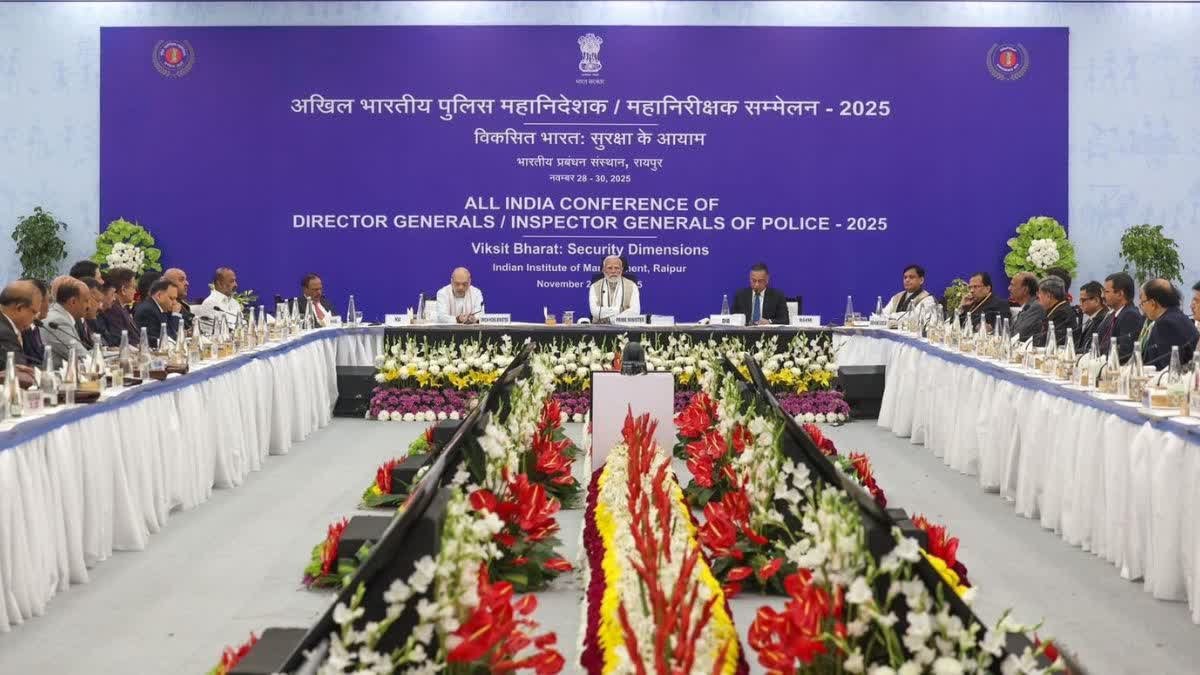

Raipur: The three-day DGP and IGP Conference concluded on Sunday at IIM Raipur, the capital of Chhattisgarh. The conference emphasized the need to strengthen policing, change public perception of the police, and increase awareness about new criminal laws. At the conference, Prime Minister Narendra Modi presented a comprehensive vision for developing the country’s security system to meet future needs.
PM Modi chaired the 60th All India Conference of Directors General and Inspectors General of Police. He appealed for improved policing. The theme of the three-day conference was “Developed India: Security Dimensions,” and detailed discussions were held on modern policing, forensic capabilities, counter-terrorism, radicalization, women’s safety, and disaster management.
What Happened on the First Day?
The DGP/IGP Conference began on Friday, November 28th. The best police stations in the country were honored on this day. By the year 2025, the top 10 police stations were selected from a total of 70, of which three were honored at the national level. Union Home Minister Amit Shah chaired the session on the first day. On this occasion, he stated that Naxalism will be completely eradicated from the country by the next DGP meet. Amit Shah stated that accuracy of intelligence, clarity of objective, and synergy of action are the key factors. The Union Home Minister emphasized that by working on these three points, we are continuously attacking radicalism, extremism, and narcotics. What happened on the second day of the DGP conference?
PM Narendra Modi chaired a total of four sessions on the second day of the DGP and IGP conference. Regarding this conference, PM Modi said that discussions and brainstorming are ongoing on various aspects of India’s security system. On this occasion, PM Modi called for adopting best practices and innovations. Several issues were discussed on the third day of the DGP conference.
PM Modi addressed a total of two sessions on the third day of the All India DGP and IGP meet. He stressed the need to change public perceptions about the police, increase outreach to youth, strengthen urban and tourist policing, and raise awareness about new criminal laws.
Appealing to Incorporate Technology in Investigations
PM Modi urged the integration of technology into investigations. He stated that technology, artificial intelligence, and NATGRID integration should be used more extensively. Furthermore, PM Modi emphasized innovation in island security, coastal policing, and forensic-based investigations.
Detailed Discussion on National Security
The third day of the DGP Conference saw detailed discussions on national security priorities, including the Vision 2047 policing roadmap, counter-terrorism trends, women’s safety, tracking fugitives, and forensic reforms. The PM emphasized the need for disaster preparedness and strengthened collaboration. He urged the adoption of a whole-of-government approach to manage cyclones, floods, and natural emergencies. PM Modi appealed to the police leadership to modernize policing methods and align them with the national vision of a developed India.
India is rapidly moving towards becoming a developed nation, so the security infrastructure must be designed keeping in mind the needs of the next 25 years. This will be a decisive step towards a developed India 2047 – Narendra Modi, PM
Need for Change in Police Image and Working Style
The Prime Minister stressed the need to enhance professionalism, sensitivity, and responsiveness in policing. He said that it is crucial to create a positive image of the police among the youth. The police must no longer be a “force” but a “face of service and trust.” Communication with the public, trust, and empathy should be the new standards of policing. Plan to Strengthen Urban Policing and Tourist Police
The PM said that given India’s rapid urbanization and growing tourism, modernizing urban policing is essential. He stressed the need to revitalize the tourist police, provide better training, and redesign city security strategies. He said that this system will also be important for tourism and investment.
The need for widespread awareness about new judicial laws
The Prime Minister described the Indian Judicial Code (BNS), the Indian Evidence Act (BSA), and the Indian Civil Defence Code (BNSS) as the foundation of the modern justice system. He said that awareness about these laws should be spread among the general public and officials. He said that these new laws will completely transform the old colonial structure and make the justice system more efficient and citizen-centric.
Focus on Banned Organizations and LWE Areas
PM Modi called for continuous monitoring of banned organizations and the overall development of areas free from left-wing extremism. He also emphasized the need to implement new models to strengthen coastal security to ensure strict monitoring of illegal activities in coastal areas.
The PM said that drug abuse poses a threat to both society and the country. He stressed the need for a comprehensive strategy encompassing enforcement, rehabilitation, and community-level intervention. He said that coordinated efforts at all levels are essential in the fight against drugs.
“Regular monitoring of banned organizations is essential.”
PM Modi emphasized the need to establish a system for regular monitoring of banned organizations in the country. He reiterated the importance of ensuring the full development of areas free from left-wing extremism and adopting new models to strengthen coastal security. Prime Minister Modi emphasized the need for a whole-of-government approach to combat drug abuse, including enforcement, rehabilitation, and community-level intervention.
The conference discussed in depth several national security issues. The long-term roadmap for policing for Vision 2047, emerging trends in counter-terrorism and counter-radicalization were discussed. The use of technology to enhance women’s safety, strategies to bring back Indian fugitives abroad, and strengthening forensic capabilities for effective investigations and prosecutions were discussed.
“Strong preparation and coordination are essential.”
PM Modi emphasized the need for strong preparation and coordination. This includes cyclones, floods, and other natural emergencies, including the current situation of Cyclone Ditvaah. He urged strengthening mechanisms for effective disaster management during such natural disasters.
Proactive planning is essential to save lives and minimize disruption during such natural disasters. This, along with real-time coordination, prompt response, and a whole-of-government approach, are essential. Police leadership needs to transform the style of policing to meet the expectations of a developing country that is on its way to becoming a developed India – Narendra Modi, PM
This year’s DGP and IGP conference was very productive. We all discussed various aspects in accordance with the theme ‘Developed India: Security Dimensions’. As for the police force, the need to continue focusing on professionalism, sensitivity, and responsiveness was emphasized – Narendra Modi, PM. PM Modi presented the President’s Police Medals for Distinguished Service to officers of the Intelligence Bureau. He also presented awards to three cities that performed best in urban policing. This award was first instituted to promote innovation and improvement in urban policing. The conference began on November 28th and concluded on November 30th.
CM Expresses Happiness Over Successful Event
Chhattisgarh Chief Minister Vishnudev Sai expressed his happiness over the successful DGP Conference. Speaking to the media, he said, “The successful completion of the DGP Conference in Chhattisgarh is a matter of pride for us. The presence of the Honorable Prime Minister Narendra Modi, Union Home Minister Amit Shah, Union Minister of State for Home Affairs, DGPs from across the country, and top officials of security forces over the past three days has further enhanced the prestige of this event. I express my heartfelt gratitude to everyone for the successful organization. Chhattisgarh is dedicatedly committed to serving the nation.”

