

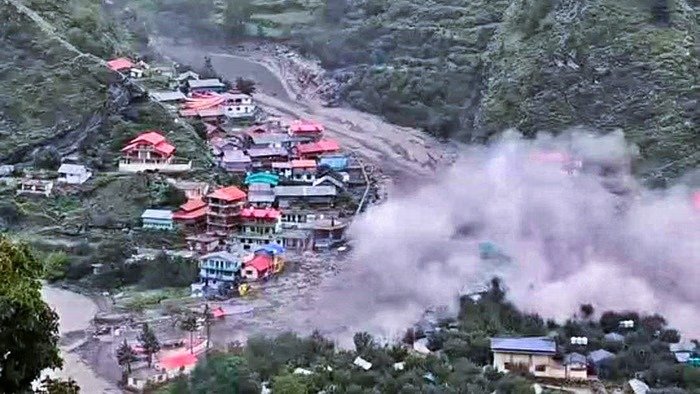

Dehradun: The Indian Institute of Remote Sensing had already predicted through satellite studies how much havoc 24 hours of heavy rain can cause in Harshil and Dharali. According to this, after 24 hours of rain, 50 to 60 lakh liters of water per second came to Dharali and Harshil, which brought debris with it.
An agreement was signed between the Uttarakhand State Disaster Management Authority (USDMA) and the Indian Institute of Remote Sensing (IIRS) under the Indian Space Research Organization (ISRO) for timely assessment, monitoring and prevention of natural disasters occurring in the hilly areas of Uttarakhand using satellite technology.
Under this, IIRS has done a satellite study of Harshil Valley, the upper part of Bhagirathi. IIRS is monitoring glaciers, glacier-lakes, debris flow, avalanches and landslides through satellite system. It is assessing the potential danger in the areas around them and providing timely information to the responsible departments including USDMA so that loss of life and property can be reduced.
Maps and danger zones prepared from satellite
Scientists have prepared maps and danger zones from satellite in the upper Mandakini, Bhagirathi and Alaknanda basins. It has been told that glaciers are decreasing rapidly in these areas between 2020 and 2023. The glacier of Bhagirathi is shrinking by 0.22% per year, Mandakini by 0.7% per year and Rishiganga by 0.11% per year. They measured the size of glacial lakes in both pre- and post-monsoon seasons, which is continuously increasing. 60 lakh liters of water per second came to Dharali’s Kheerganga and Harshil
Scientists prepared a flood map and water filling map to estimate the possible flood during heavy rains. Simulation of water flow and flood depth was done for 24-hour rain conditions in Bhagirathi valley. It was clear from this that if there is 200 mm of rain in 24 hours, then 8000 cumecs i.e. about 80 lakh liters of water per second will come down. According to about 150 mm of rain in the upper areas of Dharali, Harshil on August 5, it is clear that 60 lakh liters of water per second has come to Dharali’s Kheerganga and Harshil, which has also brought with it a huge amount of already deposited debris.
IIRS mentioned in the annual report
IIRS has clearly mentioned the MoU with USDMA and Satellite Based Mountain Hazard Assessment and Monitoring (MHAM) in its annual report for 2023-24. All the apprehensions are also shown in it through graphs. Especially the possibility of rain in Harshil Valley and flood, debris and damage accordingly is also included in it. The question is at what level this data received on the basis of MoU in USDMA has been analyzed for rescue or not.
Action should be taken by fixing responsibility of negligent officers
Senior BJP leader Ravindra Jugran has demanded Chief Minister Pushkar Singh Dhami to investigate the matter of not taking action despite IIRS warning in advance about the disaster in Dharali, Sukhitop, Harshil of Uttarkashi. He alleged that the Disaster Management Department has now become a scam management department. He is also going to submit a report in this regard to the Chief Minister soon. He said that all the guilty officers of the Disaster Management Department and Disaster Management Authority should be identified immediately. Punitive action should be taken against all of them and a case should be registered for the loss of life and property due to their negligence and inaction.

